At a glance:
High-performing ad creative now burns out in days, not weeks. Meta's algorithm optimizes for short-term efficiency and exhausts your best work faster than you can react.
ROAS is the last metric to fall. By the time you notice it dropping, you've already been overspending for 3-5 days.
The fix isn't better ads. It's a creative system: enough variations across angles, formats, and funnel stages to keep the machine fed without burning out your brand.
One-off design work can't keep up. The founders winning at paid media have a designer who understands their numbers, not just their brand guidelines.
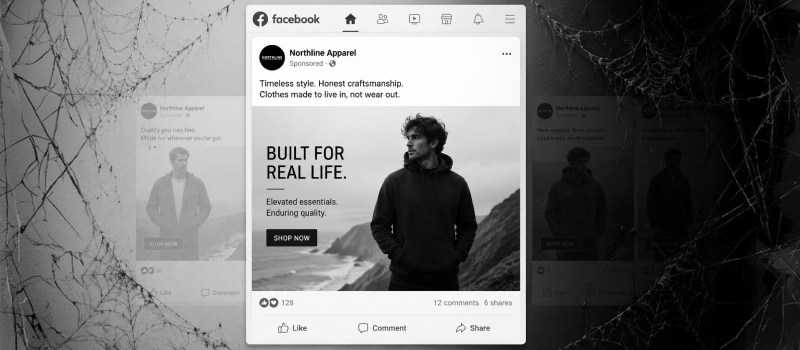
That ad you launched two weeks ago. The one that crushed for the first five days. Great CTR, low CPA, your Slack channel lit up.
Check it now. It's dying. Or it's already dead.
This isn't a failure of your creative. It's the system working exactly as designed. And if you don't understand how, you'll keep pouring money into the same trap.
Why creative dies faster now
Meta's delivery algorithm is built for short-term efficiency. It finds the people most likely to click, shows them your ad aggressively, and moves on. The better your ad performs on day one, the faster it reaches the people who will engage with it. And the faster those people see it enough times to stop caring.
In 2026, the average lifespan of a high-performing paid social creative is measured in days. Not weeks. Not months. Days.
The old playbook of launching a campaign, letting it run for a month, and optimizing based on weekly reports is dead. The algorithm ate it.
The metric that lies to you
Most founders watch ROAS. It feels like the number that matters most. Revenue in, spend out.
Here's the problem: ROAS is the last metric to fall.
Before your return drops, your frequency climbs. Before your frequency climbs, your CTR starts sliding. Before your CTR slides, your audience has already seen the ad enough times to build immunity to it.
By the time ROAS looks bad in your dashboard, you've been overspending for three to five days. That's not a rounding error. On a meaningful ad budget, that's thousands of dollars funneled into creative that stopped working before you noticed.
The early warning sign is frequency. When it crosses 2.5, engagement starts declining across most industries. That's your actual deadline, not the ROAS chart.
The hero ad trap
Here's what most founders do. They hire a designer, or an agency, or find someone on Fiverr. They get a set of ads made. Maybe three or four variations. They launch, one of them hits, and they ride it.
When it dies, they go back to the designer. Another round. Another invoice. Another two-week turnaround. Meanwhile, the algorithm is starving for fresh creative and your CPA is climbing.
This is the hero ad trap. You're betting everything on one great piece of creative, then scrambling when it inevitably burns out. You're always reactive, always behind, always paying the premium for urgency.
The founders who are winning on paid media in 2026 aren't doing this. They're not looking for the one perfect ad. They're building a system that never runs dry.
What a creative system actually looks like
A creative system isn't complicated. It's just intentional.
It means having enough variations across different angles, formats, and funnel stages that you can rotate fresh creative in before the old batch dies. Not after.
In practice, that looks like three to five new ad variations per week. Not three to five entirely new concepts. Variations. Same core message, different visual treatment. Same offer, different hook. Same product, different angle of the same story.
A static image version and a motion version of the same idea. A testimonial cut and a product-focused cut. A short-form version for stories and a longer version for feed.
This is not about volume for volume's sake. It's about giving the algorithm enough material to find winners while you retire the losers before they drain your budget.
The rule is simple: if an ad isn't performing in the first 72 hours, cut it. It's not warming up. It's dying.
Why one-off design work can't keep up
A creative system needs someone who can move fast without losing the thread. Someone who knows your brand well enough to produce variations without a brief for each one. Someone who watches the same dashboards you do and understands that a frequency of 3.1 means it's time to ship, not time to schedule a kickoff call.
That's the case for a designer on retainer. Not a one-off project. Not a batch of deliverables every quarter. An ongoing relationship where the designer understands your business, your audience, your numbers, and your brand well enough to keep the system running.
A Fiverr designer can make you a good ad. They can't build you a system. They don't know which hook your audience responded to last month. They don't know that your best-performing format is a 4-second motion loop, not a static carousel. They don't have the context, and context is the whole game.
The reframe
Stop thinking about ad creative as a deliverable. Start thinking about it as an operating system.
The deliverable model works like this: brief, design, launch, wait, panic, repeat. The system model works like this: a steady rhythm of variations shipping every week, informed by performance data, built on deep brand knowledge, with underperformers killed early and winners iterated fast.
One model is always catching up. The other is always ahead.
Your best ad is going to die. The question is whether the next one is already in the pipeline or whether you're about to start a frantic email chain.
If you're spending real money on ads and your creative process is still "batch and pray," that's the conversation worth having. heypash.com