
At a glance:
On May 20, Figma shipped an AI agent that lives inside your file and uses your design system as its source of truth.
That one detail changes everything: the agent is only as good as the structure your designer already built.
It has no product judgment, no idea who your users are, and falls apart on multi-screen flows.
For founders, the value of a designer just moved from pushing pixels to building the system the machine runs on.
The teams who invested in structure just got a force multiplier. The teams who didn't just got exposed.
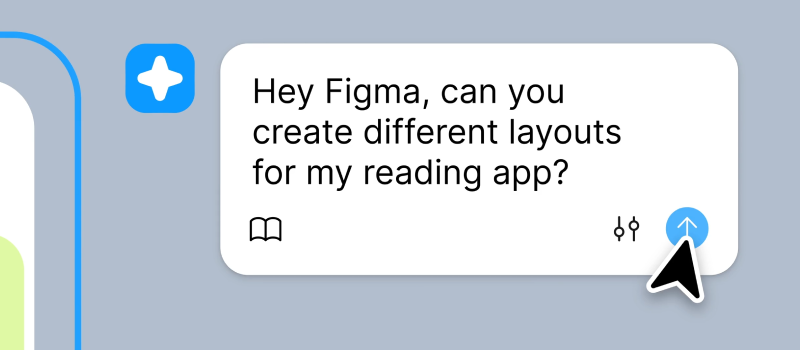
On May 20, Figma put an AI agent directly inside your design file.
Not a sidebar tool. Not a plugin. An agent that lives on the canvas, reads your components, and can generate screens, run bulk edits, and rework whole flows from a sentence of instruction.
The headlines went where headlines always go: is this the end of designers?
Wrong question. The interesting part is buried in how the thing actually works.
The detail everyone skipped
The Figma agent uses your design system as its source of truth.
Your components. Your tokens. Your spacing scale. That is what it pulls from when it builds.
Which means the output is a direct mirror of the structure you already have. Feed it a clean, well-built design system and it produces work that looks like your product. Feed it a folder of detached frames, inconsistent buttons, and forty shades of grey, and it produces confident garbage.
Figma's own guidance says the quiet part out loud: the agent's results are mediocre when the design system is poorly structured.
So the agent did not replace the designer. It made the designer's earlier work suddenly load-bearing.
What it can actually do
Credit where it is due. This is a real tool, not a demo.
It drafts screens from a text prompt. It iterates on something you already have. It runs bulk edits across dozens of frames at once. It swaps components and tokens across an entire flow. You can even run several agents in parallel on different jobs.
For a designer, that is a genuine speed unlock. The 91% of designers who say AI tools improve their work in Figma's State of the Designer report are not lying to you. The grunt work shrinks. The exploring gets faster.
Figma also wired in Claude Code and Codex through partnerships with Anthropic and OpenAI, so the design-to-code handoff is tightening too.
This is not hype. Figma did $333 million in revenue last quarter, up 46% year over year. The tool people feared would kill design is selling harder than ever.
What it cannot do, and why that matters to you
Here is the list founders need to actually read.
The agent has no product judgment. It does not know your users, your business model, or the one constraint that makes your roadmap make sense.
It cannot see anything outside the file. Your user research, your Linear tickets, the reason you chose this onboarding over the obvious one. None of it.
It struggles with multi-screen flows. Branching logic, state changes, what happens when a user does the wrong thing. Single screens are fine. Real journeys break it.
It writes bland microcopy. Plausible, generic, brand-free.
And it does not give you accessibility compliance. It produces something that looks accessible and still needs a human to check focus order and the rest.
Notice the pattern. Everything the agent is bad at is the exact work that decides whether a product converts, retains, and gets trusted. Speed, it has handled. Judgment, it has not touched.
So the designer's job didn't shrink. It moved.
A year ago, a chunk of a designer's day was production. Building the screens, nudging the spacing, making the third variation.
The agent eats most of that.
What is left is the part that was always the actual job: deciding what to build, structuring the system everything draws from, and protecting the small decisions that move a business metric.
That is not a smaller job. It is a more valuable one. The data backs it: designers who leaned into AI are 25% more likely to report rising job satisfaction. The ones who stood still are the ones feeling the squeeze.
The designer who built you a clean system just became the most leveraged person on your team. Every prompt anyone runs now inherits their work.
What this means if you hire design
Three things change for you, starting now.
First, stop paying for pixels and start paying for systems. The deliverable that matters is no longer a stack of screens. It is the design system underneath them, because that is what every future AI output will be built from. A founder who skips the system to save money is quietly capping the quality of everything the agent will ever generate.
Second, you can move faster than you think, but only on a good foundation. If your product already has real structure, your team can now explore and ship at a pace that was not possible last month. If it does not, the agent will just help you produce inconsistency faster.
Third, judgment is the thing you are buying. The market is about to flood with on-brand-looking screens generated by people with no product sense. The differentiator is no longer who can make it look good. It is who knows what to make and why. That has always been the expensive, rare skill. AI just made it the only one worth paying for.
The reframe
The Figma agent is not a replacement for a designer. It is a mirror held up to the work a designer already did.
Good system, brilliant output. No system, fast mess.
The founders who win the next year are not the ones who fire their designer to save money. They are the ones who get a designer to build the structure the machine runs on, then let the machine run.
If your design system is held together with hope and detached frames, that is the thing to fix first. Everything downstream depends on it now.
Want a second pair of eyes on whether your design foundation can actually carry AI-speed work? That is the kind of thing I help founders with at heypash.com.